What I Actually Believe About Executive Decisions
A manifesto in three acts. No jargon. No slide decks.
I have spent seven years walking into people's companies. Not as an auditor, not as a trainer, not as a therapist. I walk in as someone who sits in the room with the founder at the moment the hard decision can no longer be postponed. After hundreds of those moments, I've arrived at three convictions I can no longer ignore. I'm writing them down because I think they need to be said plainly, not wrapped in coaching language or visual frameworks.
If something in what follows resonates, we almost certainly have something to talk about. If not, at least I was direct.
I. Good decisions don't come from more information
This is the first illusion I encounter. The CEO who wants one more report. The founder who wants one more round of discussions. The manager who wants to look at the numbers again. Everyone is collecting information as though, at some point, the volume of data will automatically produce clarity.
It doesn't. I know this from direct experience, and cognitive science confirms it: beyond a certain threshold, more information doesn't improve decision quality it degrades it. The brain enters overload, activates conservation mechanisms, and either decides impulsively or postpones indefinitely.
"If you feel you need more information before deciding, in 80% of cases the problem isn't information. It's that you don't know what criteria to apply to the information you already have."
I work constantly with founders who have all the data. They know what they need to do. And yet the decision doesn't come. Not because something is missing from the information picture but because the criteria picture is unclear. Who has priority: growth or stability? Loyalty to the team or performance? The relationship with the investor or the internal direction?
Clarifying criteria before deciding that's the real work. Not gathering one more dataset.
II. My role isn't to give you decisions it's to draw them out of you
People who reach out to me sometimes have the wrong expectation: that I'll bring the answer. That after 30 minutes of conversation, I'll say "do X" and the problem is solved. It doesn't work like that. Not because I don't have opinions I do, and I share them when relevant. But because a decision that doesn't come from within the leader won't be executed with conviction.
This is one of the most consistent laws in my work: weak implementation doesn't come from poor strategy. It comes from un-owned decisions. The founder who does what the consultant told them, without understanding why, will sabotage the implementation. Perhaps involuntarily. But they will.
"The decision strategist doesn't bring solutions from outside. They create the conditions in which the right solution becomes obvious to the person who needs to decide. And to execute."
My process looks like this: I enter your company, identify where the blockage is occurring, examine the mechanisms keeping it active and then we work together so you arrive at the decision through your own criteria, not mine. At the end, it's not my decision. It's yours. And that's precisely why it will be implemented.
III. Every company under 50 people is a mirror of its founder's internal mechanisms
This is the conviction that disturbs people most. I've said it directly to founders with 40, 60, 80 employees. The reaction is almost always the same: one second of resistance, followed by recognition.
Your company is built on your decisions. Its structure, its speed, the way the team communicates, the type of problems that keep returning all of this is a projection of the way you process reality. Not because you're "toxic" or "dysfunctional." But because every leader builds systems that resemble them.
"If your company has a type of problem that repeats the same tensions, the same blockages, the same conversations re-run it's not a process problem. It's an architecture problem. And you are the architect."
This is not a reproach. It's an extraordinary opportunity. If you are the source of the structure you are also the source of the change. You don't need to hire an external COO, change the entire team, or redesign processes from scratch. You need to recalibrate a few internal mechanisms. The rest follows.
If you've read this far
Something in what I've said resonated enough. Maybe you recognize one of these convictions in your own company. Maybe you realize you've been postponing a decision for more than 30 days. Maybe you feel your company has hit your decision ceiling not the market's, not the team's.
I didn't write this manifesto to be interesting. I wrote it to be clear. We work well together when we share at least one of these three convictions. If you've read all three and nodded along we almost certainly have something to talk about.
Next step
If you've read this far, we're very likely a good fit.
Book a conversation.
Book a conversation →15 minutes. No cost. I respond personally within 24h.
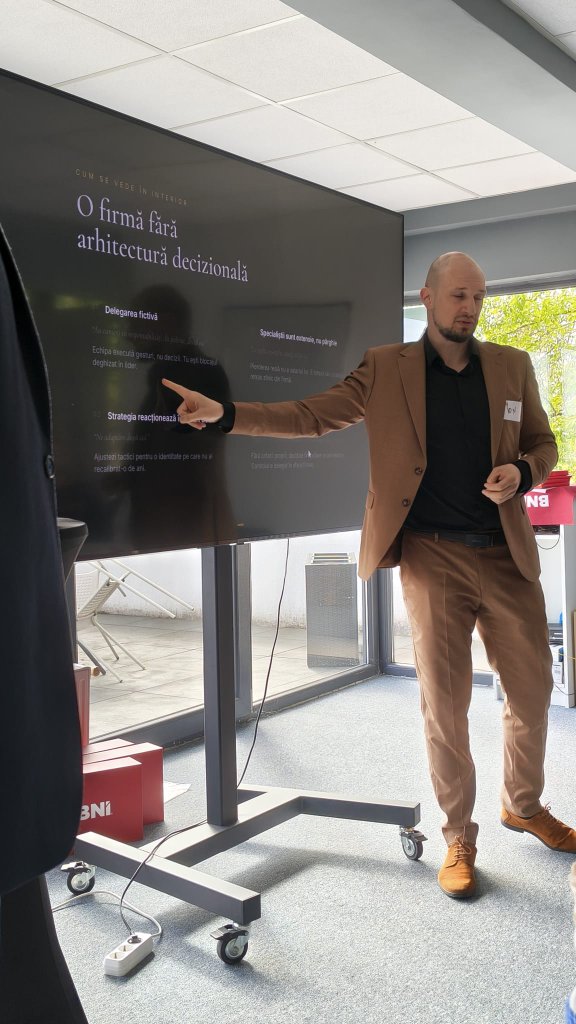
Ion Pițoiu
Decision Architect. Founder of Decision Core System™. Working with founders and CEOs across Romania and Europe for 7+ years.
LinkedIn →